

which it says will bring sets to life with sound, light and reaction to movement.
However, the new product range has got a mixed reaction from play experts, who say it risks undermining what makes Lego distinct for children in an increasingly digital world.
Announced at the Consumer Electronics Show (CES) 2026 in Las Vegas, the Danish toymaker’s Smart Play system introduces new electronic components to the classic plastic blocks.
Lego says its new tech-enabled products, launching in March with a new Star Wars set, are its “most revolutionary innovation” in nearly 50 years.
Share
Save
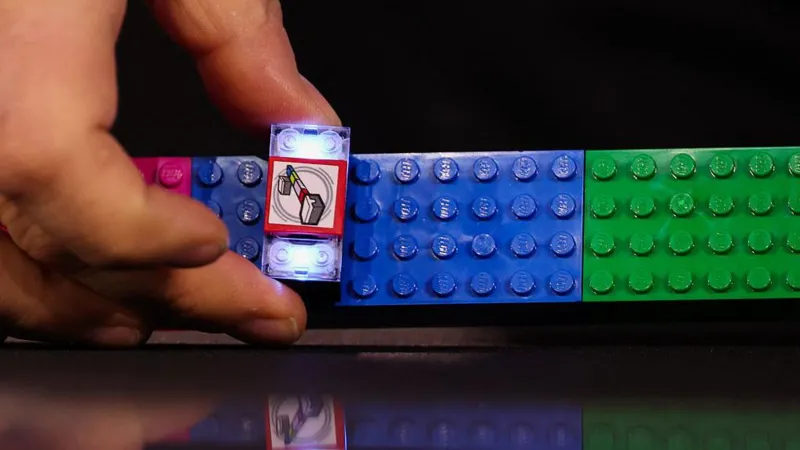
AFP via Getty Images A close-up of a hand constructing a lit-up Lego Smart Brick on a set of pink, blue and green Lego blocks.AFP via Getty Images
Lego has unveiled Smart Bricks – tech-filled versions of its small building blocks – which it says will bring sets to life with sound, light and reaction to movement.
However, the new product range has got a mixed reaction from play experts, who say it risks undermining what makes Lego distinct for children in an increasingly digital world.
Announced at the Consumer Electronics Show (CES) 2026 in Las Vegas, the Danish toymaker’s Smart Play system introduces new electronic components to the classic plastic blocks.
Lego says its new tech-enabled products, launching in March with a new Star Wars set, are its “most revolutionary innovation” in nearly 50 years.
But Josh Golin, executive director of children’s wellbeing group Fairplay, believes Smart Bricks could “undermine what was once great about Legos” – harnessing children’s own imagination during play.
He said the toy did not require extra features to generate sounds or other effects.
“As anyone who has ever watched a child play with old-school Legos knows, children’s Lego creations already do move and make noises through the power of children’s imaginations,” he told the BBC. “
Andrew Manches, professor of children and technology at the University of Edinburgh, agreed the beauty of Lego lay in “the freedom to create, re-create, and adapt simple blocks into endless stories powered by children’s imagination”.
But he also welcomed Lego’s efforts to integrate physical and digital play with tools that react to the way children interact with its Smart Play products.
Julia Goldin, the company’s chief product and marketing officer, previously told the BBC it viewed digital technology as an opportunity to “expand physical play and physical building”.
“We don’t look at the digital world as a threat,” she said – adding its smart range weaves interactivity “seamlessly” with its physical products.
Lego says its Smart Bricks can sense motion, position and distance, allowing the models to respond in various ways during play.
Measuring 2×4, the brick itself contains sensors, lights, a small sound synthesiser, an accelerometer and a custom-made silicon chip enabling it to detect movement and react to it.
But it is designed to be used with Smart Minifigures and Smart Tags tiles – two additional products making up Lego’s Smart Play System.
Similarly adapted from existing Lego components, these possess digital identifiers triggering different sounds or reactions when they detect and interact with each other.
For instance, when tried out by the BBC at CES, a Lego birthday cake recognised when its “candles” were blown out – sounding a cheer and a happy birthday song.
Meanwhile, a Lego helicopter made whooshing sounds when moved or rotated, with its Smart Brick lighting up red upon crashing.
Translate This Article