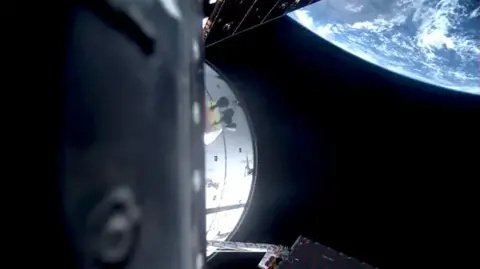
The translunar injection burn began at 19:49 EDT (23:49 GMT) and lasted for just under six minutes
“Humanity has once again shown what we are capable of,” Canadian astronaut Jeremy Hansen says, in his first words after the completion of the burn
Nasa hails the procedure as “flawless” and says all the astronauts are “doing great”
The spacecraft began the burn at its lowest point of orbit relative to Earth, our science correspondent explains
No-one will land on the Moon during this mission, the Orion capsule will just circle it – how long does it take to get there.
The craft’s solar wings were fully deployed not long after launch, giving it power to help sustain its journey.
About the size of a minibus, its never been flown in space before by humans so pilot Victor Glover is spending the day pushing it to the extreme.
Nasa want to be sure Orion is voyage-worthy before the crew push on into deep space from where there is no easy return.
They’re testing out the life support systems too. But if something goes wrong, the crew has specially-designed suits that could keep them alive for around six days.
What are the crew doing?
Unlike the Apollo missions in the 1960s and 1970s, we can watch a huge amount of what’s happening on this voyage as Nasa livestreams the mission.
Cameras above the astronauts’ heads show them checking monitors, holding up mobile phones, and pressing buttons.
Then about eight hours after launch, the crew were allowed their first sleep onboard.
Translate This Article