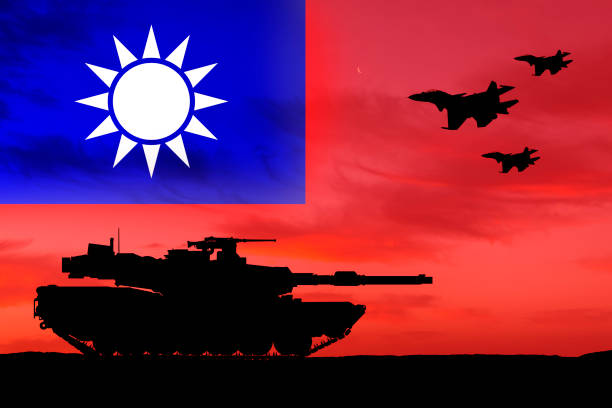
Taiwanese President Lai Ching-te’s aim to push through a $40 billion defense spending plan is mired in a stalemate as the opposition parties demand compromises, drawing fire from China hawks in the Senate who fear a looming invasion by Beijing.
President Trump has pushed Taiwan to increase its defense spending in light of the growing threat from China, which views the island as part of its territory. Chinese President Xi Jinping, who has instructed his military to be ready to invade Taiwan by next year, warned Trump during a recent phone call that the U.S. should be cautious about its arms sales to Taipei. The two leaders are set to meet in person in April.
Lai and his Democratic Progressive Party, which lost the majority in the Taiwanese Parliament, said it would increase defense spending to more than 3 percent of gross domestic product (GDP) in 2026, but political divisions have resulted in the defense spending proposal being blocked 10 times, creating a political deadlock that shows no signs of easing.
“I think the political fissures in Taiwan are very deep,” said Lyle Goldstein, director of the Asia Program at Defense Priorities. “The society, I would say, as a whole, is increasingly polarized there. The president, William Lai, his party has, in my view, suffered quite a few setbacks over the last year, and so this has kind of, I would say, kind of strengthened the hand and the will of the opposition, which is kind of, let’s say, feeling emboldened.”
Last week, the Kuomintang (KMT) party and Taiwan People’s Party (TPP) voted down the Democratic Progressive Party’s motion to review the nearly $40 billion special defense budget bill intended to be spread out over eight years. The amount would help purchase the eight weapons systems — including howitzers, Javelin antitank missiles and HIMARS rocket systems — that were approved as part of the U.S.’s $11 billion sale in December.
Taiwan’s government says blocking the massive defense budget would delay improvements to the armed forces and send the wrong signal to Taipei’s international allies. Some of the top defense-focused lawmakers in Congress agree.
Sen. Tammy Duckworth (D-Ill.), who sits on the Senate Armed Services Committee, said as Taiwan continues to face threats from China, it is paramount that Taipei has the resources to defend itself.
“I’ve spoken with my counterparts in Taiwan for the last year discouraging any drastic cuts like these — and I hope they change course,” Duckworth said in a statement to The Hill on Friday.
Sen. Dan Sullivan (R-Alaska), who is also a member of the Senate Armed Services Committee, said earlier this week on the social platform X that Taiwan’s Legislature adjourned last week without passing the “budget necessary for Taiwan to defend itself. Meantime, the leadership of the opposition party responsible for this, the KMT, is in Beijing meeting with the CCP and planning bigger engagements.”
“It doesn’t take a genius to figure out what’s going on here,” Sullivan said. “I’ve warned before – short changing Taiwan’s defense to kowtow to the CCP is playing with fire.”
Sen. Roger Wicker (R-Miss.), the chair of the Senate Armed Services Committee, said he was “disappointed” the opposition parties slashed Lai’s defense budget so “dramatically.”
“The original proposal funded urgently needed weapons systems,” Wicker said Monday on X. “Taiwan’s parliament should reconsider—especially with rising Chinese threats.”
The chair of the TPP, Huang Kuo-chang, reportedly accused Raymond Greene, the top U.S. diplomat on the island, of “excessive interference” in Taiwan’s internal affairs, after backing Lai’s defense budget increase proposal.
KMT said that it supports strengthening Taiwan’s defense capabilities but noted legislative oversight and fiscal responsibility are “essential to long-term defense planning.”
“While multi-year defense budgets may support strategic continuity, they must be accompanied by detailed planning, clear allocations, and effective oversight to prevent waste and inefficiency,” the party said in a statement on social media this week. “In addition, ongoing delays in the delivery of critical military equipment underscore the need for realistic planning and accountability.”
Steve Yates, senior research fellow for China and national security policy at the Heritage Foundation, said the KMT pulled a “risky” move, and he warned the party is “playing with fire.”
“They are putting Taiwan at risk by taking this move, not just in terms of ‘will this be at cross purposes with the Trump administration,’ but they are approving several billion dollars in added spending, which Beijing will not like,” Yates said in an interview with The Hill on Friday. “They are cutting short on the promised investment, which surely won’t look good in the eyes of reasonable people in Washington.”
Sens. Jim Risch (R-Idaho), the chair of the Senate Foreign Relations Committee, and Jeanne Shaheen (N.H.), the top Democrat on the panel, urged Taiwan’s political parties to work across the aisle to fully fund the island’s defense budget, noting that China’s military exercises near Taiwan in December are a “reminder of Beijing’s intentions toward Taiwan and its threats to a free and open Indo-Pacific.”
“Instead of pursuing photo opportunities with the Chinese Communist Party, leaders in Taiwan must focus on approving funding for critical military reforms and improvements in whole-of-society resilience,” the pair said in a statement Friday. “We urge party leaders in Taipei to expeditiously approve vital investments in Taiwan’s security and continued partnership with the United States.”
Yates, a former deputy national security adviser to former Vice President Dick Cheney, commended the handful of senators for voicing concerns on the issue, although he was “disappointed” that more policy leaders in Congress and the media have not spoken out.
Goldstein, of the Defense Priorities think tank, argued that it is inappropriate for U.S. lawmakers to tell Taiwanese officials what they need for their defense, as he would not expect Taiwan legislators to “tell Americans what may be for their defense.”
“I myself would argue that this is a debate internal to Taiwan,” he said in a Friday interview with The Hill. “It has a very powerful impact on Taiwan’s future, and I think we should trust the people of Taiwan to sort their way through this.”
Under the “One China” policy, the U.S. does not officially recognize Taiwan’s independence, though presidents have offered varying assurances to defend Taiwan should China attack.
The Trump administration barred Lai from landing in the U.S. last year as Trump was looking to strike a trade deal with China, but recently, the president said he would be disappointed if China invaded Taiwan.
“He considers it to be a part of China, and that’s up to him, what he’s going to be doing,” Trump said of Xi in a January interview with The New York Times. “But, you know, I’ve expressed to him that I would be very unhappy if he did that, and I don’t think he’ll do that. I hope he doesn’t do that.”
The White House said it “strongly” supports Taiwan’s efforts to boost its defense and deterrence “through reforms and a commitment to increasing defense spending.”
“We welcome President Lai’s announcement on Taiwan’s intent to spend over 3 percent of GDP on defense in 2026 and 5 percent by 2030,” a senior Trump administration official told The Hill on Friday. “We refer you to the Taiwan authorities for specifics related to Taiwan’s defense programs.”
The State Department did not immediately respond to a request for comment.
Translate This Article