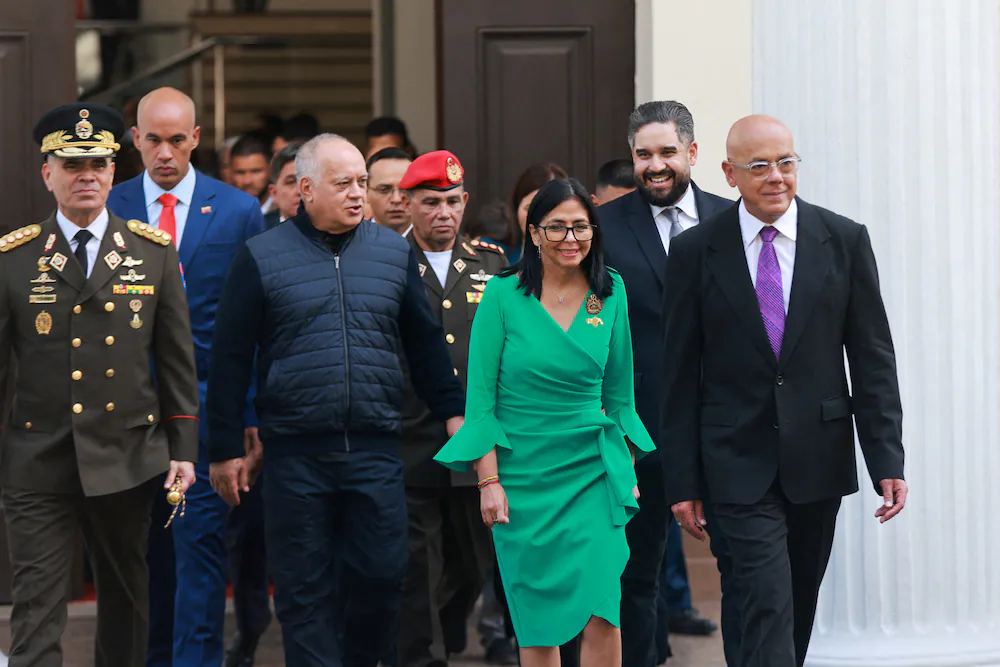
The Venezuelan interim president has launched the search for possible traitors while ensuring submission to Washington.In today’s schizophrenic Venezuela, two discourses coexist. One, directed toward the outside world, was put in writing by Delcy Rodríguez and speaks of working “jointly” with the United States, while remaining silent about Washington’s decision to control energy resources and force Venezuela to buy only American products with the money generated; another, directed internally, concentrates executive and legislative power in a single family — the Rodríguez siblings — and accentuates the repressive model.
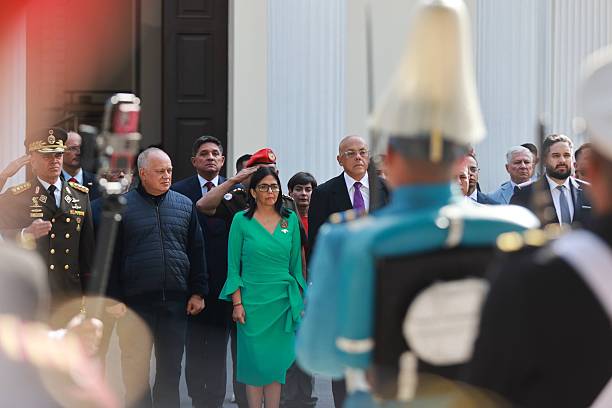
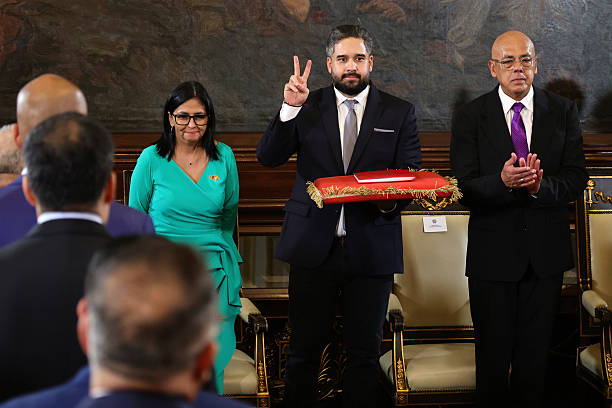
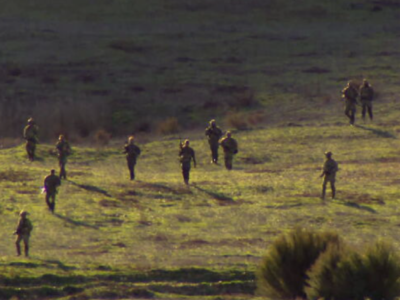
For those at home, the message from the new presidency is that nothing has changed and the revolution continues its march, “firmer than ever,” which includes a purge in search of accomplices of the embarrasing U.S. incursion into the heart of Caracas, which ended with at least 56 soldiers dead (Venezuelans and Cubans from Nicolás Maduro’s security detail), according to official figures from Caracas and Havana, and the Chavista leader in a New York court a few hours later.
In that vein, the government leaked the name of its first high-profile arrest: General Javier Marcano Tabata. The military officer closest to Maduro was detained on Tuesday, labeled one of the great traitors, in the regime’s desperate search for scapegoats to explain why the radars failed to function or why the multimillion-dollar investment in fighter jets and communication systems proved useless — systems that weren’t even activated that night.
Until the day of his arrest, Marcano was the head of the presidential honor guard and director of the DGCIM, the Venezuelan intelligence agency that for many years was headed by Hugo “El Pollo” Carvajal. They didn’t even wait for him to arrive home: the arrest took place in the National Assembly chamber, and from there he was taken directly to jail, after a confusing exchange of gunfire on January 6 in front of Miraflores Palace, in which drones and soldiers fired on each other.
It has since emerged that the incident, never officially clarified, was related to the arrest of General Marcano. Reports from Colombian intelligence — an effective source of information on events in the neighboring country and accessed by the Colombian press — indicate that Marcano is accused of facilitating the kidnapping of Maduro. His involvement consisted of providing the United States with the exact coordinates of where Maduro and First Lady Cilia Flores were sleeping, and identifying blind spots in the Cuban-Venezuelan security ring protecting them. According to these reports, he was the man infiltrated by Washington, and they add that encrypted communications between the general and foreign intelligence agencies were detected weeks before January 3.
Having overcome the initial shock, the fear of another Delta Force incursion remains a real threat that Trump’s inner circle periodically stirs up. That is why, to replace Marcano, Delcy Rodríguez has decided to surround herself with hardliners and has chosen General Gustavo González López as the new commander of the honor guard. González López served as Minister of the Interior and director of the Bolivarian National Intelligence Service (SEBIN) until the end of 2024.
The SEBIN is the regime’s political police, responsible, among other things, for the notorious Helicoide prison, a symbol of torture and repression against the opposition. Human rights organizations have previously accused González López of alleged abuses during his tenure as head of the SEBIN, which resulted in sanctions from the United States and the European Union. “He’s one of the hardliners. His appointment sends no signal of change,” says opposition deputy Stalin González, echoing the double standards employed by Chavismo both within and outside Venezuela. According to the independent Venezuelan media outlet Efecto Cocuyo, General González López is included on the U.S. Treasury Department’s sanctions list.
While the Maduro regime, in the absence of Maduro himself, consolidates its control and repression in the streets, with armed groups of motorcyclists roaming freely through Caracas, the external reality is aligning itself with U.S. tutelage. Although Diosdado Cabello has threatened in recent days to cut off all oil supplies to the United States in the event of any aggression — “not a drop,” he repeated — the reality is that the new Venezuelan administration remains silent in the face of the humiliating announcements by Trump and Marco Rubio, which indicate that all Venezuelan energy resources will fall under Washington’s control. The Venezuelan government has also silently accepted Trump’s announcement that the “interim authorities in Venezuela will send between 30 and 50 million barrels of oil to the United States of America.”
But it’s not just about silence. The reshuffling of the men surrounding Delcy Rodríguez is focused more on appeasing the United States than on standing up to it. Another appointment in recent hours was that of Calixto Ortega Sánchez, designated Vice President for the Economy. Ortega Sánchez’s profile is that of a man loyal to the president, educated in the United States, with a master’s degree from Columbia University, an MBA in energy from Rice University’s Graduate School of Business, and studies in banking and finance at the University of London.
Before taking charge of the economic portfolio, Ortega Sánchez was Venezuela’s consul in New York (2013–2017) and Houston (2008–2013), as well as a delegate to the United Nations Administrative and Budgetary Committee for a brief period in 2007. Ortega Sánchez aims to address Washington’s demands without making too much noise, while trying to pull Venezuela’s ailing economy out of intensive care amid a devaluation of the local currency of almost 500%, fueling fears of hyperinflation.Until the day of his arrest, Marcano was the head of the presidential honor guard and director of the DGCIM, the Venezuelan intelligence agency that for many years was headed by Hugo “El Pollo” Carvajal. They didn’t even wait for him to arrive home: the arrest took place in the National Assembly chamber, and from there he was taken directly to jail, after a confusing exchange of gunfire on January 6 in front of Miraflores Palace, in which drones and soldiers fired on each other.
It has since emerged that the incident, never officially clarified, was related to the arrest of General Marcano. Reports from Colombian intelligence — an effective source of information on events in the neighboring country and accessed by the Colombian press — indicate that Marcano is accused of facilitating the kidnapping of Maduro. His involvement consisted of providing the United States with the exact coordinates of where Maduro and First Lady Cilia Flores were sleeping, and identifying blind spots in the Cuban-Venezuelan security ring protecting them. According to these reports, he was the man infiltrated by Washington, and they add that encrypted communications between the general and foreign intelligence agencies were detected weeks before January 3.
Having overcome the initial shock, the fear of another Delta Force incursion remains a real threat that Trump’s inner circle periodically stirs up. That is why, to replace Marcano, Delcy Rodríguez has decided to surround herself with hardliners and has chosen General Gustavo González López as the new commander of the honor guard. González López served as Minister of the Interior and director of the Bolivarian National Intelligence Service (SEBIN) until the end of 2024.
The SEBIN is the regime’s political police, responsible, among other things, for the notorious Helicoide prison, a symbol of torture and repression against the opposition. Human rights organizations have previously accused González López of alleged abuses during his tenure as head of the SEBIN, which resulted in sanctions from the United States and the European Union. “He’s one of the hardliners. His appointment sends no signal of change,” says opposition deputy Stalin González, echoing the double standards employed by Chavismo both within and outside Venezuela. According to the independent Venezuelan media outlet Efecto Cocuyo, General González López is included on the U.S. Treasury Department’s sanctions list.
While the Maduro regime, in the absence of Maduro himself, consolidates its control and repression in the streets, with armed groups of motorcyclists roaming freely through Caracas, the external reality is aligning itself with U.S. tutelage. Although Diosdado Cabello has threatened in recent days to cut off all oil supplies to the United States in the event of any aggression — “not a drop,” he repeated — the reality is that the new Venezuelan administration remains silent in the face of the humiliating announcements by Trump and Marco Rubio, which indicate that all Venezuelan energy resources will fall under Washington’s control. The Venezuelan government has also silently accepted Trump’s announcement that the “interim authorities in Venezuela will send between 30 and 50 million barrels of oil to the United States of America.”
But it’s not just about silence. The reshuffling of the men surrounding Delcy Rodríguez is focused more on appeasing the United States than on standing up to it. Another appointment in recent hours was that of Calixto Ortega Sánchez, designated Vice President for the Economy. Ortega Sánchez’s profile is that of a man loyal to the president, educated in the United States, with a master’s degree from Columbia University, an MBA in energy from Rice University’s Graduate School of Business, and studies in banking and finance at the University of London.
Before taking charge of the economic portfolio, Ortega Sánchez was Venezuela’s consul in New York (2013–2017) and Houston (2008–2013), as well as a delegate to the United Nations Administrative and Budgetary Committee for a brief period in 2007. Ortega Sánchez aims to address Washington’s demands without making too much noise, while trying to pull Venezuela’s ailing economy out of intensive care amid a devaluation of the local currency of almost 500%, fueling fears of hyperinflation.-El Pais
L
Translate This Article