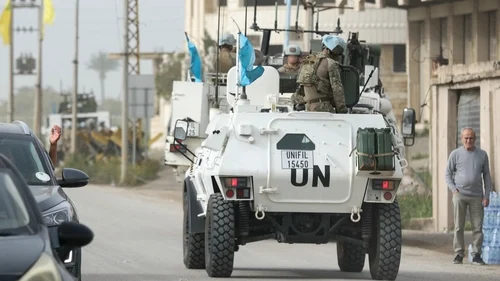
A French soldier was killed and three others wounded while clearing a road in southern Lebanon in an attack that UNIFIL peacekeepers and French officials said was likely carried out by Iran-backed Hezbollah.
In calls with Lebanese President Joseph Aoun and Prime Minister Nawaf Salam, French President Emmanuel Macron condemned the “unacceptable attack”, his office said in a statement.
Three other members of the United Nations’ UNIFIL peacekeeping mission were injured, UNIFIL said, two of them seriously.
UNIFIL said initial assessments indicated the fire came from non-state actors, allegedly Hezbollah, and that an investigation had been launched into what it called “a deliberate attack.”
Macron also said the evidence so far pointed to the Iran-backed armed group and urged Lebanese authorities to act against those responsible.
Hezbollah denied any involvement in the attack, expressing its “surprise at positions that rushed to make baseless accusations” against the group.
French armed forces minister Catherine Vautrin said the patrol was ambushed while on a mission to open a route to a UNIFIL post that had been isolated by fighting in the area.
The soldier was killed by direct small-arms fire, she said. UNIFIL said the attack occurred in the southern Lebanese village of Ghandouriyeh.
Lebanon’s army condemned the shooting and said it had opened an investigation.
President Aoun offered condolences and ordered an immediate probe, while Prime Minister Salam also condemned the attack.
UNIFIL was first deployed in 1978 and has remained through successive conflicts, including a 2024 war during which its positions came under repeated fire.
Israeli military kills militants in the south
Separately, the Israeli military said it had killed members of a “terrorist cell” that violated a US-brokered ceasefire and approached its soldiers in southern Lebanon.
It said it was authorised to take necessary self-defence measures against “threats,” adding that such actions are not restricted by the ceasefire.
Israel and Lebanon agreed a “cessation of hostilities” on 16 April 9pm GMT for an initial period of ten days to enable peace negotiations between the two countries, according to a text of the deal released by the US State Department.
The deal does not require Israel to withdraw from southern Lebanon, where Israeli troops have been destroying villages and infrastructure after ordering residents south of the Litani River to flee.
The area makes up about 8% of Lebanese territory.
Israeli army says established ‘Yellow Line’ in Lebanon, like in Gaza
Israel’s military has said it has established a “Yellow Line” demarcation in southern Lebanon, similar to one separating its forces from Hamas-held areas in Gaza.
“Over the past 24 hours, IDF forces operating south of the Yellow Line in southern Lebanon identified terrorists who violated the ceasefire understandings and approached the forces from north of the Yellow Line in a manner that posed an immediate threat,” it said, referring to such a line for the first time since a ceasefire came into effect.
“In order to eliminate the threat… forces attacked the terrorists in several areas,” it said, noting that the military was authorised to act against threats.
“Actions taken in self-defence and to remove immediate threats are not restricted by the ceasefire,” it said.
Translate This Article