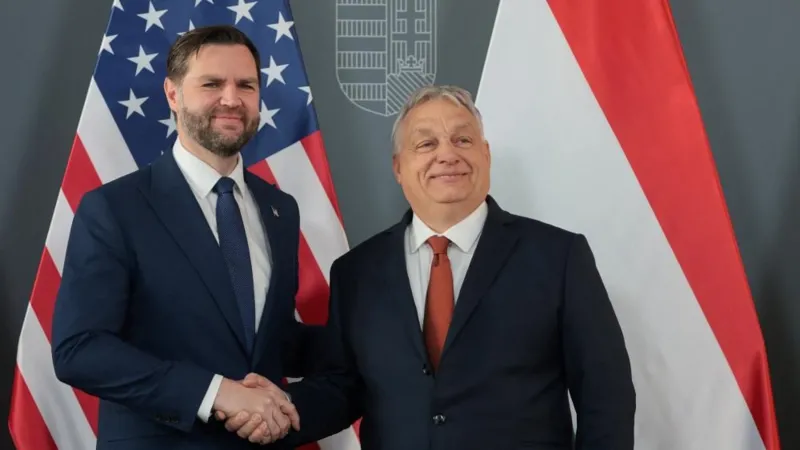
The veteran prime minister is a key European ally of the Trump administration, as well as being Russian President Vladimir Putin’s closest partner in the EU.
After winning four elections in a row since 2010, Orbán faces the toughest challenge in a political career going back almost 40 years.
In a last-ditch bid to boost the prime minister before the 12 April vote, Vance and his wife Usha arrived in Budapest for the first top-level US visit to Hungary for 20 years. They were welcomed by Foreign Minister Péter Szijjártó, who said Orbán’s friendship with President Donald Trump had created a “new golden age” in relations.
Péter Magyar responded to the visit by saying his Tisza party welcomed Vance to Budapest, and that when his party came to office it would consider the US as a prominent partner, both as a Nato ally and as an economic partner.
Following talks with Orbán, Vance launched a bitter attack on the European Union and Ukraine.
He accused the EU of “one of the worst examples of foreign election interference that I have ever seen or ever even read about… because they hate this guy”.
Vance added that “part of the reason” for his visit was because “interference that’s come from the bureaucracy in Brussels has been truly disgraceful”.
Speaking later at an Orbán campaign rally, he said: “We want you to make a decision about your future with no outside forces pressuring you or telling you what to do. I’m not telling you exactly who to vote for but what I am telling you is that the bureaucrats in Brussels, those people should not be listened to.”
He ended his speech urging those present to “go to the polls in the weekend, stand with Viktor Orbán, because he stands for you”.
EU leaders have been frustrated for weeks that Orbán has slapped a veto on billions of euros of essential funding for Ukraine, even though he agreed to it last December. German Chancellor Friedrich Merz spoke of “a gross act of disloyalty”.
However, they have carefully avoided getting caught up in the Hungarian election campaign.
Vance’s remarks were reminiscent of a speech he gave in Munich in February 2025, when he accused European leaders of placing restrictions on freedom of speech.
He also repeated unsubstantiated claims that Kyiv had become involved in the election campaign, without giving details, alleging “elements within the Ukrainian intelligence services [had] tried to put their thumb on the scale of American elections, on Hungarian elections. This is just what they do”.
Orbán has made hostility to Ukraine and its president, Volodymyr Zelensky, a cornerstone of his campaign.
When the government of Serbia – Hungary’s neighbour to the south – announced that explosives had been found and neutralised near the TurkStream gas pipeline, close to the border with Hungary, Orbán and pro-government media labelled the incident a terror attack on Hungary’s energy supply. Ukraine swiftly declared it had nothing to do with the incident, suggesting it was a “Russian false-flag operation”.
Former intelligence sources in Hungary, and the opposition leader Péter Magyar, accused Orbán of staging the incident with the help of the Serbian President Alexander Vucic to boost his chances of re-election next Sunday.
Reuters A woman in lilac with flowers walks alongside two men in suits beside a flagReuters
JD Vance (C) and Usha Vance (L) were greeted at Budapest airport by Hungary’s foreign minister
Trump’s friendship with the Hungarian leader goes back to 2016, when Orbán was the first and only EU leader to support him in the US presidential election. He strongly backed Trump for re-election in 2024, and was in Washington last October to secure an exemption for Hungary from US sanctions on Russian oil giants Rosneft and Lukoil.
Trump later made clear that the exemption was a personal deal between himself and Orbán – implying that if Orbán lost this election, his successor would have to re-apply.
On Tuesday, he spoke to those at Orbán’s campaign rally on speakerphone after Vance called him, describing the prime minister as “a fantastic man” and saying that the pair “have had a tremendous relationship”.
Hungary, almost alone among EU countries, has defied calls from Brussels to wean itself off Russian fossil fuels. In Washington, Orbán also committed to buying more US liquefied natural gas (LNG), as well as US nuclear technology and fuel. Hungary depends heavily on Russian oil through the Druzhba pipeline from the east, and on Russian gas through the TurkStream pipeline from the south.
Both sources are now problematic. No oil has reached Hungary through the Druzhba pipeline, which crosses Ukraine, since the end of January. Orbán blames Ukraine for failing to restore the pipeline after a Russian attack on oil infrastructure in western Ukraine on 27 January.
To prevent shortages, Hungary has been forced to release fuel reserves and import non-Russian oil through an alternative pipeline from Croatia.
Reuters Orbán at a rally in MarchReuters
The election is billed as Orbán’s toughest challenge in decades of politics
Other recent scandals also appear to have dented his po[CENSORED]rity.
Private telephone conversations between Foreign Minister Szijjártó and top Russian officials over several years have been leaked.
Transcripts suggest that Szijjártó regularly keeps the Russian government informed about confidential discussions at European Union summits, and lobbied to get Russian officials off the sanctions list at Moscow’s bidding. Szijjártó has defended the calls as “normal diplomacy”.
Orbán has been accused by the European Parliament of running a “hybrid regime of electoral autocracy”, and Hungary is now assessed as the most corrupt country in the EU by Transparency International. Big state projects have been awarded to figures within Orbán’s inner circle, and the main media companies have been bought up by his allies.
Billions of euros of EU funding have been withheld from the government because of concerns over failings in the rule of law.
Hungarian Prime Minister Viktor Orban has convened an emergency meeting of the National Defence Council after explosives were found near a pipeline that transports Russian gas to Hungary.
The discovery in a border area of neighbouring Serbia comes as Orban’s party is badly trailing in opinion polls ahead of crucial elections next Sunday.
Opposition leader Peter Magyar accused him of “panic-mongering” orchestrated by “Russian advisers”, days after security experts warned of a possible “false flag” operation that could be blamed on Ukraine.
Orban, an ally of Russian President Vladimir Putin, has resisted EU calls to abandon Russian energy imports since the full-scale invasion of Ukraine.
In recent weeks Hungarian security experts have raised the possibility of a staged operation, either on Hungarian or Serbian territory, intended to arouse enough sympathy for Orban to help his Fidesz party win the election – or to give Orban an excuse to declare an emergency and postpone or cancel the vote.
Serbian President Alexander Vucic, a close ally of Orban, informed the Hungarian leader of the discovery on Sunday morning.
Two rucksacks full of explosives and detonators were found by the Serbian army near the village of Tresnjevac in the Kanjiza district, about 20km (12 miles) from the point where the TurkStream pipeline crosses into Hungary.
“Our units found an explosive of devastating power,” Vucic said in a post on Instagram. “I told PM Orban that we would keep him updated on the investigation.”
Hungary receives between five and eight billion cubic metres of Russian gas a year through the TurkStream pipeline, which both Hungary and Slovakia depend on for Russian gas.
Balint Pasztor, president of the Vojvodina Hungarian Association, and another key Orban ally, posted on Facebook: “If the investigation proves that we were not the primary target after all, but rather Hungary’s supply lines, then this makes it even clearer: the terrorist attack was planned with the aim of bringing down Viktor Orban.”
Fidesz has made hostility to Ukraine a cornerstone of its election campaign.
At election rallies Orban has told supporters that low heating and fuel prices in Hungary are only possible thanks to cheap Russian oil and gas, both of which arrive in Hungary by pipeline – oil through Ukraine, and gas through the Balkans.
Orban alleges that a “Kyiv-Brussels-Berlin” axis is conspiring to stop Hungary getting cheap Russian fuel, to impose their “puppet” prime minister Magyar in the upcoming election. A Tisza government, Orban says, would also drag Hungary into a European war against Russia.
Orban has already accused Ukrainian president Volodymyr Zelensky of imposing “an oil blockade” on Hungary, because no Russian oil has arrived through the Druzhba pipeline, which crosses Ukrainian territory, since the end of January.
Ukraine says the pipeline was damaged in a Russian attack, and should be functional again in-mid April.
Who is Viktor Orban, Hungarian PM fighting to stay in power after 16 years?
War in Ukraine spills into Hungarian election campaign
There have been no official allegations of Ukrainian involvement in the pipeline incident so far. But one well-informed Serbian source told the BBC this could happen as early as Monday, when Serbian authorities are expected to release the first results of their investigation.
The Ukrainian government pre-empted any accusations of involvement on Sunday. “Ukraine has nothing to do with this,” foreign ministry spokesman Heorhiy Tykhyy said in a post on X. “Most probably, a Russian false-flag operation as part of Moscow’s heavy interference in Hungarian elections.”
On 2 April, Hungarian security expert Andras Racz warned on Facebook that a “fake attack” on the TurkStream pipeline could be staged inside Serbia.
Racz also predicted that the explosives would be identified as Ukrainian, allowing Orban to once again point the finger of blame at Kyiv.
“We had some solid preliminary information about this operation, including details about the place and possible timing,” former senior Hungarian counter-intelligence officer, Peter Buda, told the BBC.
“It’s clear that Ukraine’s interests aren’t at stake here. An operation like this would help Orban before the election by influencing public opinion in his favour.”
The Hungarian government insists the threat is real. “In the past few days and weeks, we’ve seen it all,” Hungarian Foreign Minister Peter Szijjarto wrote on Facebook.
“The Ukrainians organised an oil blockade against us. Then they tried to impose a total energy blockade on us by firing dozens of drones at the TurkStream pipeline while it was still on Russian territory.
“And now we have today’s incident, in which Serbian colleagues found explosives capable of blowing up the pipeline.”
Opposition leader Peter Magyar accused Orban, in cahoots with the Serbian president, of staging the latest incident.
“He will not be able to prevent next Sunday’s election. He will not be able to prevent millions of Hungarians from ending the most corrupt two decades in our country’s history.”
Viktor Orban’s Fidesz government in Hungary stands accused of mass voter intimidation in a film released on Thursday ahead of 12 April parliamentary elections, in which the ruling party is trailing in the opinion polls.
The Price of the Vote documentary film, which aired on Thursday evening at a Budapest cinema and on YouTube, presents the results of a six-month investigation by independent filmmakers and reporters.
In the film, voters, mayors, former election officials and a police officer claim that large sums of money and even illegal drugs are being offered to pressure people to vote for Fidesz.
Fifty-three of Hungary’s 106 individual constituencies and up to 600,000 voters are targeted, the film alleges – potentially 10% of the expected turnout of six million.
After 16 years of Fidesz rule under Orban, most recent polls indicate that the party is trailing Peter Magyar’s centre-right opposition party Tisza by at least that margin.
EPA A man with cropped hair and a fancy blue jacket stands at a microphoneEPA
Peter Magyar’s Tisza party is bidding to oust Fidesz from power
All the constituencies involved are rural or small-town communities, increasingly dominated by Fidesz since 2010.
The film portrays a rural Hungary made up of a patchwork of poor villages, home especially to the country’s large Roma minority.
Local mayors exercise an iron grip over daily lives, providing work, firewood, transport to polling stations and, in one case, even access to medicine, in exchange for the “correct” vote on election day, according to claims made in the film.
The BBC has reached out to individual government ministers, and the communications offices of the government, the interior ministry, and the national police for a reaction.
The only response so far has been from Minister for Public Administration and Regional Development Tibor Navracsics, who is seen as a moderate.
“If there is any wrongdoing just let the ministry of interior do its job,” Navracsics replied. He declined to comment on specific allegations in the film.
It was in January that Viktor Orban addressed a large gathering of local mayors and village and town councillors in Budapest: “Mayors, ladies and gentlemen, the situation is the following: this election must be won by you.”
“The 2026 election will be decided by whether you get involved. If you do, we’ll win; if you don’t, we won’t.”
De Akcióközösség A van stands outside a school gate in a Hungarian village, with two chairs on the groundDe Akcióközösség
Outside a polling station in the village of Tiszabura, which saw a mayoral election rerun repeatedly last autumn
In the film, Orban’s words are juxtaposed with interviews with around 20 figures across 14 of Hungary’s 19 counties, from the south to the north-east.
The sheer extent of the practice, and the similarity of the stories in villages tens or hundreds of kilometres apart led the filmmakers to conclude that the action is planned by senior Fidesz officials.
“In the beginning, we thought the key piece of this process is vote-buying. But then we realised that the money is just the icing on the cake. The key word here is dependency and vulnerability,” Aron Timar, one of the filmmakers, told the BBC.
“The money comes in on a pretty serious scale, and with quite a large entourage,” says one interviewee, a serving police officer whose face and voice is disguised, in the documentary.
“I didn’t become a police officer to serve a corrupt system. To help cover things up.”
In one village, the Fidesz mayor is also the district doctor for a catchment area covering 32 settlements. Patients say they fear they will not receive their prescription if they do not vote for the party.
Firewood is only distributed to those who vote for the party, several people interviewed claim.
In another, a former candidate dropped his bid for elected office, after the child protection office allegedly threatened to take his children into care.
The authorities did not want him running against the candidate preferred by the governing Fidesz party, he claims.
De Akcióközösség A woman blurred with a childDe Akcióközösség
This Roma woman in northern Hungary said her children were at risk of being taken away because her husband tried to run for office
One day after the crew filmed in a certain village, the police allegedly visited the hotel where they stayed to ask for the guest list.
“We believe that most of the policemen in the country are fair people. So this is not about the police force. This is more about the political influence on the police,” filmmaker Timar told the BBC.
For voters offered money, the sum mentioned is usually 50-60,000 forints (£110-£133) per vote – a significant sum in communities where child benefit is only £26-£43 per child per month.
But the filmmakers emphasise that what they describe is far more than a vote-buying operation.
At previous elections, some of the villages cited in the film have recorded votes of 80%-100% for Fidesz.
Practices alleged by characters in the film include the provision of cars and minibuses on election day, voters pretending to be illiterate in order to obtain a “companion” in the voting booth, photographs of voting slips to prove a vote for Fidesz, and chain voting.
Standing beside Orbán, Vance said he was in Budapest “to help him in this campaign cycle” although he conceded the US would “work with whoever wins this election”.
Orbán’s main rival Péter Magyar is well ahead in most opinion polls.
The veteran prime minister is a key European ally of the Trump administration, as well as being Russian President Vladimir Putin’s closest partner in the EU.
Translate This Article