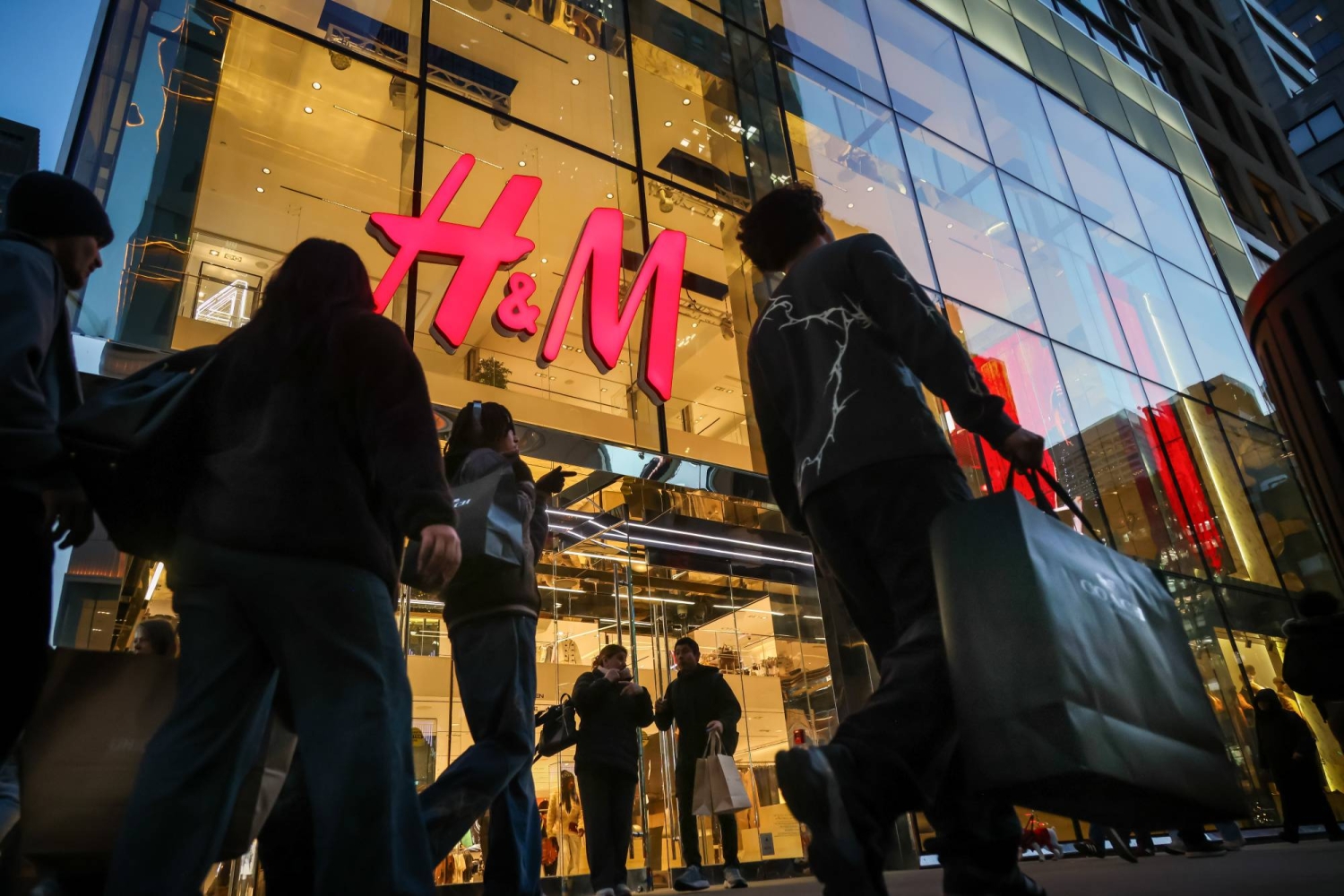
From a conference room atop H&M’s headquarters in the heart of Stockholm — with its brown-toned wood and clean lines giving the space a distinctly Scandinavian feel — Chief Executive Officer Daniel Erver speaks of reviving the one-time Swedish highflyer. What he’s up against is a credibility problem.Eight years ago, after a record quarterly sales drop, Hennes & Mauritz’s then-CEO Karl-Johan Persson, a scion of its billionaire founding family, had gathered shareholders in the historic Stockholm concert hall Cirkus for its first — and only — capital markets day to reassure them that things would get better. They didn’t. Just weeks after the event — where Persson had cut a dapper figure, tie-less, in a white shirt and an Arket suit — the company dumped more bad news: roughly $4 billion in unsold garments and a 62% drop in operating profit.
Now, Erver — who took over in 2024 — is seeking once again to convince investors that the group has turned a corner. Alongside an ambitious remake, Erver has sought to dig H&M out of one of the biggest inventory pileups in modern retail. While those efforts are bringing richer operating margins and profits, they have yet to lead to sustained sales growth, and Erver is asking for patience.
“We have begun to lay a stable foundation for future growth,” the 44-year-old Swede, a quintessential insider who’s spent his entire career at the company, said in an interview on April 1. “That can be seen in increased profitability, better cash-flow earning capacity, lower inventory levels … Over time that will lead to us seeing stronger growth. I think we are at the beginning of the journey, but it is a long-term journey.”
Time is something investors are reluctant to give the company. From its 2015 peak, H&M has lost roughly half its market value, erasing tens of billions of dollars in equity. Just two years earlier, it had been Stockholm’s most-valuable listed company.
H&M’s inability to stack up in the $1.9 trillion global apparel market against Zara-owner Inditex on the higher end and an onslaught from cutthroat price-driven competitors like Shein and Primark means investors are unwilling to bite. And there’s little to suggest that trend will be reversed anytime soon — H&M’s sales on a constant currency basis slid 1% in its first quarter.
“I think the margin improvement that H&M has managed to achieve under Erver is impressive, but I still miss growth at the company,” said Lars Soderfjell, head of Nordic Equities at Finland’s Alandsbanken Abp. “The big question is whether H&M is still relevant to its core customers — women aged 15 to 30.”
H&M was slow to grasp the structural changes in the industry, which was transformed dramatically in the last decade by digitalization. Without the need for a physical store, hundreds of new competitors popped up, changing the retail landscape entirely.
Erver says the steps he put in place are helping H&M deal better with the new environment. He whittled away layers to take decisions faster, streamlined the number of suppliers, bringing more of them closer — to Morocco and Egypt from China and Bangladesh — and got designers to scale up products. That’s helped bring down H&M’s inventory-to-sales ratio to the lowest level in 10 years, and prepared it to better take on “brutal, tough competition, and competitors that come from all directions,” he said.
“We have higher ambitions for growth over time — to drive both our customer value and shareholder value — by starting to grow more than we have done in recent years,” he said.
A decade ago, H&M and Inditex were seen as peers. The two generated broadly comparable earnings in the early 2010s. In market value, however, Inditex started to break away after around 2012.
By 2016, growth at the Spanish group took off while H&M fell behind. The gap widened further in the years that followed, particularly after the pandemic. Inditex’s margins rebounded strongly and remained structurally higher as its more nimble model helped it pull ahead. Today, Inditex has roughly five times H&M’s profit. While Erver has struggled to revive operating margins to 10%, Inditex’s are closer to 20%.
After a decade of missteps, investors want H&M to show it can sell more at full price, avoid inventory pileups that force fire sales and sharpen its brand — all while competing with ultra-cheap online rivals and an increasingly upmarket Zara.
On Erver’s watch, inventories have come down sharply and online operations now account for roughly 30% of sales. Store numbers have been slashed 19% from their 2019 peak, including the closure of all 130 acquired Monki shops. The core H&M brand has 832 fewer stores, with consolidation into larger flagship-style outlets — a newly renovated store on Stockholm’s Hamngatan, just blocks away from its headquarters, is set to reopen soon.
But all that may still not be enough, says Charles Allen, a Bloomberg Intelligence analyst. “Inventory days are still above 130, which is much higher than they were historically and compare unfavorably to Inditex, which is below 90,” he said. “So this suggests there is still some excess inventory. On balance I think there is more clearance to be done.”
Translate This Article