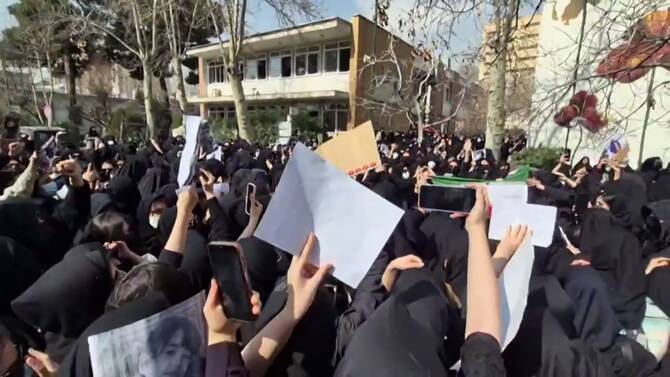
Clashes provide uneasy backdrop to third round of talks on nuclear programme in Geneva.
Iran’s campuses turn into battlegrounds again forty days after massacre.
Now, with in-person classes resumed, memorial gatherings for those killed in January’s violent crackdown have evolved into open defiance on campuses in Tehran, Mashhad and Isfahan. Some have escalated into stand-offs between protesting students and pro-establishment groups.
In a notable shift, recent rallies have included chants naming Reza Pahlavi, the exiled son of Iran’s last monarch, as “the leader of Iran’s revolution,” and calling for the restoration of monarchy nearly five decades after the 1979 revolution.
On Monday, students at the University of Tehran organized a ceremony for Mohammad Reza Mohammadi Ali, a master’s student in theology. A group known as United Students reported that the Basij student organization sought to appropriate the event, claiming the deceased had supported the government.
Opposing students responded with chants including “This flower has fallen, a gift to the homeland,” “Woman, Life, Freedom,” and “By the blood of our comrades, we stand to the end.”
At Sharif University of Technology, a silent candlelight vigil turned confrontational after university cultural officials broadcast Quran recitations and music over loudspeakers. Students holding photos of the dead protested what they described as an attempt to drown out the gathering.
Videos circulating online show rival groups facing off. Pro-government students chanted support for Supreme Leader Ali Khamenei and slogans such as “Allahu Akbar” and “Death to America,” while calling for the expulsion of those they labeled “rioters.”
Opposition chants targeted the Islamic Republic, Khamenei, and institutions such as the Basij and the Islamic Revolutionary Guard Corps.
Symbols have become vivid markers of division. Pro-government students carried the flag of the Islamic Republic and burned U.S. and Israeli flags during demonstrations. Opposition students, by contrast, covertly brought in the pre-revolutionary lion-and-sun flag — replaced after 1979 — and raised it during gatherings this week. On Monday, students at three Tehran universities also set fire to the Islamic Republic flag.
Students at two Tehran universities and one in Isfahan have also called for the restoration of their pre-1979 names, which referenced members of the Pahlavi royal family before being changed after the revolution.
University security offices — and, according to student accounts, plainclothes forces believed to be operating from outside campuses — have been present during several confrontations, at times appearing to side with pro-establishment students.
Students report identification cards being photographed and participants filmed, actions widely interpreted as intimidation. Some universities have allegedly sent text messages barring certain students from campus and warning of possible disciplinary proceedings.
The renewed campus unrest places Iran’s leadership in a delicate position. A forceful intervention risks inflaming tensions and pushing protests beyond university gates. Yet allowing sustained mobilization at institutions long regarded as incubators of political activism could embolden broader opposition.
That dilemma is complicated by a longstanding legal safeguard.
A 2000 law prohibits military, police and security forces from entering university campuses to conduct operations, make arrests or use weapons without formal authorization. The measure was enacted after the July 1999 unrest, when vigilantes and plainclothes security forces stormed dormitories at the University of Tehran, triggering nearly a week of nationwide turmoil.
Despite the law, human rights groups and media outlets have documented repeated instances over the years in which security forces entered campuses without authorization, including during recent protests.
More Stories
CIA issues rare Persian-language appeal to Iranians for secure contact
9 hours ago
Listen to this article
The Central Intelligence Agency on Tuesday published a direct message in Farsi on its official X account, urging Iranians to contact the agency securely amid ongoing domestic unrest and heightened Iran-US tensions.
“Hello. The Central Intelligence Agency (CIA) can hear your voice and wants to help you. Below is the necessary guidance on how to securely contact us virtually,” the post said, accompanied by a short video outlining encrypted communication methods.
The message marks the CIA’s most explicit Persian-language public outreach effort, similar to prior calls by Israel’s Mossad but rare for the US agency.
The move appears aimed at gathering intelligence on Iran’s nuclear and military programs, as well as domestic dissent, while providing support to potential informants.
In recent years, several intelligence services – especially the CIA, and to a lesser extent MI6 and Mossad – have normalized open, platform-based messaging that resembles advertising but is intended for secure outreach to potential sources.
In 2025, the head of MI6 used X to unveil “Silent Courier,” a Tor-only dark-web portal for people in hostile or high-risk states – particularly Russia – to contact the agency securely.
In October 2024, the CIA published text and infographic instructions in Mandarin, Korean, and Farsi on how to securely contact the agency through its public and dark‑web (onion) sites.
Mexico cartel violence revives scrutiny of Iran-linked networks
13 hours ago
Negar Mojtahedi
Listen to this article
As cartel violence grips Mexico following the death of a top drug lord, experts tell Iran International that Tehran-linked networks may be intertwined with the criminal infrastructure fueling instability across Latin America.
Mexico has deployed thousands of troops after coordinated attacks erupted across at least 20 states following the capture and death of Jalisco New Generation Cartel leader Nemesio Oseguera Cervantes, known as El Mencho.
Cartel fighters torched buses, blocked highways and clashed with security forces, leaving dozens dead and forcing authorities to mobilize nearly 10,000 personnel nationwide.
While Mexican authorities frame the unrest as cartel retaliation, security analysts say such episodes increasingly unfold within transnational financial and trafficking systems that extend beyond Mexico’s borders.
Those systems, experts say, have in some cases intersected with Iranian state-aligned networks operating across Latin America.
“There are longstanding money-laundering and trafficking ecosystems that connect Latin American cartels, Iranian state-aligned networks and global criminal finance,” investigative journalist Sam Cooper told Iran International, pointing to investigations linking criminal actors across North and South America.
Cooper who has reported extensively on transnational crime networks, stressed that the overlap does not necessarily indicate direct operational control by Tehran but reflects a convergence of interests that could benefit the theocracy during periods of heightened pressure.
“I don’t have direct evidence their intelligence would be involved in helping the cartel push back against the Mexican state,” he said. “But I do believe the Iranian regime would want to benefit very much from increasing the turmoil in Mexico.”
That convergence of illicit finance and geopolitical competition, analysts say, creates openings for states such as Iran to benefit from regional instability.
‘Using gangs for dirty work’
Janatan Sayeh, a research analyst at the Foundation for Defense of Democracies focusing on Iranian domestic affairs and regional influence, says the Islamic Republic frequently advances its objectives indirectly, relying on criminal intermediaries to apply pressure while maintaining distance from direct involvement.
“They (Iran’s regime) do try to put a distance between themselves and their criminal activity, specifically assassination plots,” Sayeh said.
“They increasingly are leveraging some of these gangs… to do the dirty work.”
In 2011, US officials brought charges against several Iranian nationals, among them an operative linked to the IRGC’s Quds Force, accusing them of conspiring to kill the Saudi ambassador in Washington.
According to prosecutors, an Iranian go-between attempted to recruit individuals he thought were tied to a Mexican drug cartel, offering payment to carry out the assassination. Those individuals were in fact informants working with the U.S. Drug Enforcement Administration.
Networks built over decades
Analysts say many of these connections trace back decades, particularly through Iran’s partnership with the former regime ruling Venezuela, where Iranian Revolutionary Guard-aligned networks and Hezbollah operatives established financial and logistical footholds across Latin America.
Hezbollah has long been accused of running criminal networks in Latin America that intersect with drug trafficking routes.
Dr. Walid Phares, a foreign policy expert and co-secretary general of the Transatlantic Parliamentary Group, said those networks gradually expanded into cooperation with organized crime groups operating across the region.
“Hezbollah had developed relationships with similar organizations across Latin America, Brazil, Colombia and beyond,” Phares told Iran International. “But the most important move backed by the IRGC regime was in Mexico.”
According to Phares, access to trafficking routes and financial channels allowed militant networks to expand their reach while maintaining distance through criminal intermediaries.
“The most important goal of Hezbollah was to get to the American and Mexican border,” he said.
Sayeh added that Western governments often mischaracterize the threat by treating such activity solely as organized crime rather than part of a broader national security challenge.
“A lot of times when it comes to the Americas it is treated as a criminal network, not a terrorism network,” he said. “Accurately labeling it for what it is important.”
For Iran, “it’s anything anti-America… and cartel is just part of that paradigm for them,” he said. “Any opportunity just to exert pressure on the Americas.”
Crime and geopolitics converge
Security specialists say the convergence has blurred the traditional boundary between criminal activity and geopolitical competition. Networks originally built for sanctions evasion and terror financing can also serve narcotics trafficking and money laundering operations, creating mutually beneficial partnerships between state and non-state actors.
For Cooper, the violence unfolding in Mexico reflects a wider shift in the Western Hemisphere, where criminal networks increasingly intersect with global rivalries.
“The level of threats that are emerging in the Western Hemisphere right now,” he said, “is all related.”
As Mexico contains the fallout from El Mencho’s death, experts say the episode highlights how criminal violence in the Western Hemisphere increasingly intersects with global power competition.
Shot, chased, denied care: how a mother was left to die in Iran’s massacre
14 hours ago
Listen to this article
A 50-year-old fitness trainer who joined a protest in Esfahan with her two children last month was shot in the head and later died after a hospital refused to admit her and security forces stopped the car carrying her, sources told Iran International.
Arezoo Abedi, a mountaineer and fitness coach, was shot on Baghe Daryacheh Street on January 8 while her children were with her, sources said.
Bystanders helped her children transport her to Saadi Hospital, but the facility declined to admit her, according to her family. They then headed toward Alzahra Hospital.
The grave of Arezoo Abedi during a memorial marking the fortieth day after her death
The grave of Arezoo Abedi during a memorial marking the fortieth day after her death
On the way, members of the Basij and other security forces stopped the vehicle and fired warning shots in an attempt to force the passengers out, sources said.
The family was eventually allowed to proceed, but Abedi died before reaching the hospital. Her body was transferred to Alzahra’s morgue.
Her family said authorities released the body after three days on the condition that no public funeral be held. She was buried at night under security presence at Bagh-e Rezvan cemetery beside her father’s grave.
The official forensic report listed the cause of death as “cardiac arrest.”
The grave of Arezoo Abedi during a memorial marking the fortieth day after her death
The grave of Arezoo Abedi during a memorial marking the fortieth day after her death
Officials in Tehran claim calm, but prices tell another story
Escalating talk of war and renewed negotiations with the United States may dominate Iran’s political discourse, but the country’s deepening economic crisis is more present in daily life—and no less likely to drive change.
On Monday morning, the Foreign Ministry spokesman said foreign reporters visiting the country had described life as “normal.” Yet the indicators and daily experience suggest anything but.
That same day, Iranian media quoted bakers and grocers saying that wealthier customers now leave deposits so poorer families can take bread or meat without paying upfront.
Even newspapers aligned with Supreme Leader Ali Khamenei have begun issuing warnings.
Khorassan cautioned about the political consequences of rising bread prices. Days earlier, Kayhan warned that bread riots were likely if the government proceeds with plans to raise prices for a fourth time since President Massoud Pezeshkian took office in mid-2024.
Tabnak, the news site run by former IRGC commander Mohsen Rezaei, reported that a family of two or three now needs about twice the government’s worst-case estimate from last year to cover food costs.
Overall inflation is above 60 percent and expected to approach 70 percent this month. Donya-ye Eqtesad warned that food inflation could soon reach triple-digit levels. The Statistical Center of Iran reports inflation for agricultural goods above 85 percent and services above 45 percent.
Across the media spectrum, analysts point to three converging pressures: soaring food prices, wages that lag behind living costs and persistent instability in financial markets.
Specialized economic outlets report continued volatility in the foreign-exchange market. The dollar has fluctuated between 1,630,000 and 1,650,000 rials in recent days, with traders describing “high-tension anticipation” tied to uncertainty over negotiations with the United States and broader political risks.
Gold prices have surged alongside the currency, placing what has long been a traditional hedge against instability beyond the reach of most households.
The stock market has added to public unease. Shargh reported sharp index declines and heavy retail capital flight on Monday, with roughly 110 trillion rials ($680 million) exiting the market in 24 hours.
Analysts cite eroding confidence in government support policies and fears that regional tensions could spill into the domestic economy. Even those with no investments feel the consequences, as market instability feeds broader uncertainty.
Ramadan, traditionally marked by nightly gatherings and shared meals, has taken on a subdued tone. Many families can no longer afford customary foods, let alone host guests.
State television and pro-government social-media accounts now openly discuss the possibility of war. Online documentaries show Tehran’s pre–New Year shopping districts open but nearly empty. Instead of browsing, residents exchange advice on stockpiling food, fuel and clothing — precautions in case the capital comes under attack.
If this is normal, it is a fragile and increasingly costly version of it.
Fatalism spreads in Iran as threat of US strike grows
20 hours ago
Maryam Sinaiee
Listen to this article
A sense of fatalistic anticipation is spreading in Iran as the threat of a US strike grows, with many expressing fear of war but also resignation that it may be unavoidable—or even transformative.
The mood appears to shift with perceived signals from Washington, where President Donald Trump this week hinted at a deadline for Tehran while repeatedly floating military options if a deal is not reached.
Asked on Friday whether a limited strike on Iran was under consideration, Trump replied: “I guess I can say I am considering that.”
The prospect of conflict has triggered widespread discussion online, where users express a mix of dread, anger, and resignation. While many fear the destruction war could bring, others describe it as an inevitable outcome of escalating tensions.
“Many of us are certainly worried about war,” one user from Iran wrote on X, “but we are more terrified of continuing to live alongside these killers who have no limits.”
“No war means the Islamic Republic stays,” another user wrote. “The choice is yours.”
Casualties—of war and protest
The killing of protesters during nationwide unrest in January, along with the wave of arrests that followed and worsening economic hardship, has left some Iranians deeply pessimistic about the country’s future under continued Islamic Republic rule.
One user arguing against those opposed to a US strike compared casualties from Iran’s recent war with Israel to deaths during domestic unrest.
“12 days at war with Israel—how many did we lose? About a thousand and something,” the user wrote. “On January 18 and 19 how many were killed? Tens of thousands; in two days! Now do you think there’s a less costly way than war to get rid of the monster?”
Skepticism about diplomacy appears widespread.
An online poll conducted by the conservative website Asr-e Iran found that nearly 80 percent of more than 27,000 respondents did not expect negotiations to produce an agreement. In another poll on the same site, more than 70 percent said they believed the United States was using talks primarily to prepare military forces in the region.
Online polls in Iran are informal and not scientifically representative, but they offer a snapshot of sentiment among politically engaged internet users.
“Friends who oppose war, why are you condemning the people?” one X user wrote. “Beg Khamenei to stop the war. The people didn’t bring the country to this point.”
‘Packing bags’
Alongside emotional reactions, some Iranians are taking practical steps in anticipation of possible conflict, sharing advice on storing food, securing essential supplies, and identifying safer areas outside major cities.
Similar patterns emerged during the brief but intense war with Israel last June, when many residents of Tehran left for northern provinces or smaller towns. Long lines formed at gas stations in the early days of that conflict, and parts of the capital were temporarily emptied.
Many also express concern over what they see as a lack of preparation by authorities, noting the absence of public shelters or clear guidance for civilians.
“The government’s reaction to war is indifference and irresponsibility,” one user wrote. “After packing a bag, what do we do? Where are we supposed to go?”
For many Iranians, the uncertainty itself has become a source of anxiety, as the threat of war—once abstract—now feels increasingly real.
Plainclothes police and security forces, many of them armed, have tried to flood Iran’s remaining open universities in an attempt to crush a fourth day of student protests against the supreme leader, Ali Khamenei.
Translate This Article